About the proportions of the face and the location of permanent makeup
Face shapes and permanent makeup
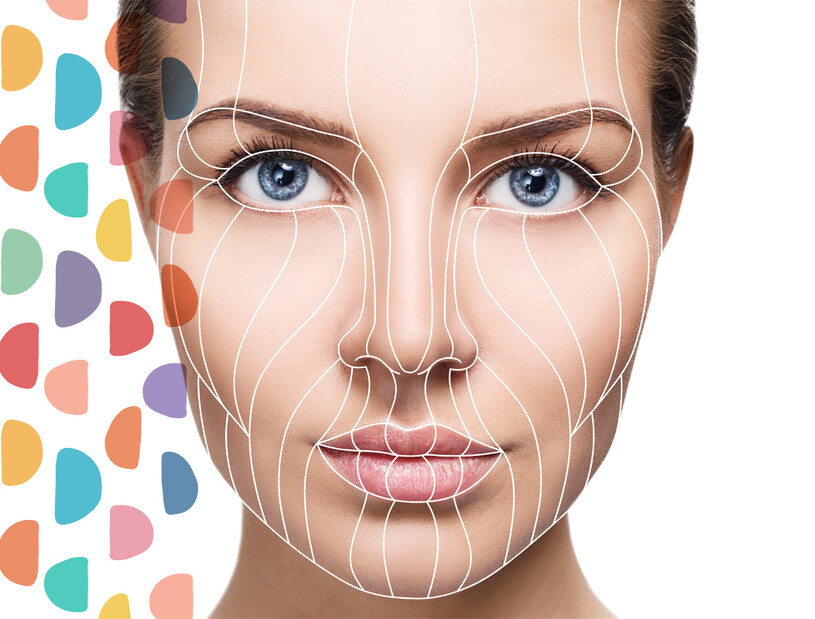
The field of permanent makeup is constantly changing. New colors, techniques for applying pigments are dictated by fashion, but the proportions and correct location of the tattoo remain unchanged.
We continue a series of feature articles about the face.
The face of a person has always been and will be a key part of the appearance. It is on the face that we pay attention, we select things to the face, attract attention and decorate - the face.
The shape of the face, its proportions, lines, features affect the impression of a person, his image as a whole. Therefore, it is very important to take into account the features of your client's face when creating an image and style.
In this article, we will consider different types and shapes of the face, talk about the features of the selection of makeup, taking into account the characteristics of the face, consider the influence of certain facial features on the perception of appearance.
Let's start... with the ideal
To definitely talk about “big eyes”, “round face”, “small nose”, you first need to decide what to consider as a starting point.
Of course, there can be no talk of “how much to hang in grams”, more precisely, what size parts of the face should be in centimeters.
Usually, when they talk about the characteristics of facial features, they mean proportions, the ratio of the sizes of different parts of the face to each other and their relationship to the face as a whole.
So what proportions are considered ideal?
1. The ratio of the length of the face (from the line passing through the lower point of the chin to the hairline) to the width of the face at its widest point is approximately 1.61 - the so-called "golden section". This ratio of the lengths of two segments to each other was used by ancient mathematicians, but it gained wide distribution - both in mathematics, and in painting, and in architecture, and in many other areas with the light hand of Leonardo da Vinci.
2. The width of the face along the line of the eyes is equal to the length of the eye from the outer corner to the inner (excluding eyelashes), multiplied by five. In this case, the ideal distance between the inner corners of the eyes is equal to one eye length. The distance from the outer corner of the eye to the ear is also equal to one eye length or slightly less. Here opinions differ: some of the sources speak of the distance between the outer corner of the eye and the edge of the face, and some of the distance between the eye and the ear.
3. The eyes are on a line dividing the head horizontally in half. This is not about the face, but about the head as a whole - from the line along the bottom point of the chin to the top of the head. The line of the eyes divides it into two equal parts.
4. The distance from the upper hairline to the eyebrow line is equal to the distance from the eyebrow line to the nose line and is equal to the distance from the nose line to the chin line.
5. The width of the nose is equal to the distance between the inner corners of the eyes.
6. The width of the mouth is equal to the distance between the irises of the eyes. Some sources suggest the distance between the pupils of the eyes, but in fact the error here is small.
If you connect the points of the outer corners of the eyes (excluding eyelashes) and the point of the middle of the edge of the lower lip with lines, you get an equilateral triangle.
7. Eyebrows. The eyebrow starts at a line passing vertically through the inner corner of the eye and the line of the wing of the nose, and ends at the point of intersection with the line drawn from the wing of the nose through the outer corner of the eye.
8. The ears are located between the line of the eyes and the line of the nose, their size corresponds to the distance between these lines.
9. The height of the chin is equal to the length of the eye.
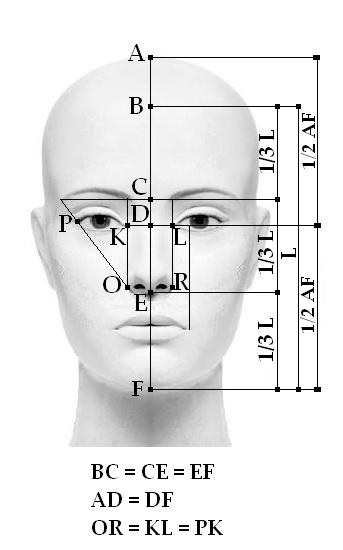
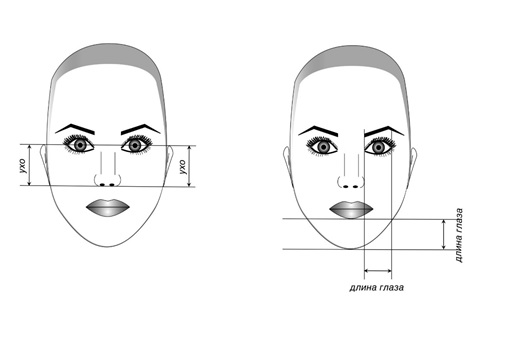
These are the basic proportions of the face. It is a significant deviation from them in one direction or another that determines the meaning of the characteristics "big", "small", "low", "high" and so on.
In the next article, we will talk about the shape of the face and how to determine it.
Read also
- "Pitfalls" of PM and how to avoid them for a novice master
- The cost of the service, or How to determine the price of permanent makeup
- Oily skin and permanent makeup: acceptable techniques
- Permanent Makeup Removal: When is a laser preferred?
- Complex permanent make-up: master's difficulties and client's fears
- It cannot be corrected: when does permanent makeup need to be removed?
- Work on oily skin: factors affecting the quality of permanent makeup
- Drawing natural eyebrows: a workshop for permanent makeup masters
- Tattoo pigments in the permanent makeup procedure: consequences of use
- Shot
- Permanent makeup