Development of Modern Technologies: Laser Techniques in the PM Room
Educational program for permanent makeup masters
Aesthetic procedures using a laser are now one of the most popular among patients. And even if the PM master does not use such devices in his practice, knowledge of their features will enrich the knowledge base
Alina Mantula , dermatovenereologist, candidate of medical sciences, head of the department at the Euroderm clinic
Aesthetic procedures using a laser are now one of the most popular among our patients. And even if you do not use such devices in your practice, knowing their features will undoubtedly enrich your knowledge base.
The time when lasers rapidly burst into our lives, we can truly consider a colossal breakthrough in the development of medical science as a whole. Now their use occupies a special place in the field of aesthetic dermatology and cosmetology. And here the versatility of the possibilities of use and the expected results are impressive and significant.
The year 1996 was marked by the beginning of the active use of lasers for hair removal: these procedures have entered our lives and are integral to a large number of women, and men too. Over the years, significant progress has been made in this direction.
Types of devices and object of influence
Most hair removal lasers target melanin, a pigment found in the shaft of the hair follicle. Melanin is able to selectively absorb light waves with a length of 700-800 nm, while there is no damage to surrounding tissues. Hair removal by light can theoretically be accomplished by three mechanisms, such as photothermal destruction through local heating, photomechanical destruction through the generation of shock waves, or photochemical destruction through the creation of poisonous mediators - singlet oxygen or free radicals.
Currently, sources that destroy hair photothermally are widely used, among them are long pulsed ruby (694 nm), long pulsed alexandrite (755 nm), long pulsed diode (810 nm), long pulsed Nd:YAG (1064 nm) and intense pulsed light. Radio frequency also damages hair photothermally. The Q-switched Nd:YAG laser (1064 nm) with or without the addition of local carbon suspension also mechanically destroys the hair. Thanks to the development of modern technologies, laser hair removal is currently the most effective and long-term method of hair removal.
Now the use of lasers in the field of dermatology has been widely and successfully proven to remove age spots, vascular pathologies, benign epidermal and intradermal skin neoplasms, and scarring of the skin. Undeniable and highly effective is the use of lasers in aesthetic medicine - for photorejuvenation, fractional skin rejuvenation.
Undoubtedly, the popularity and effectiveness of these techniques leads to an increasing number of patients preferring this type of procedure. However, unfortunately, in certain cases, complications and undesirable consequences are possible.

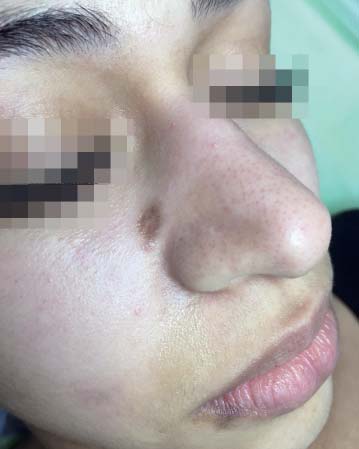
Complications after the laser
Danger #1: Burns
Burns are the most common complication. Often, the first manifestations of a burn are insignificant and look like hyperemia (redness), then swelling joins, against this background, cavity elements appear in the form of blisters, the contents of which, depending on the depth of damage and infection, can be filled with various types of contents (serous, serous-purulent or hemorrhagic). Bubbles, as a rule, are tense, after they are opened, erosions or even ulcerative defects are formed, on the surface of which there are crusts and discharge.
Subjective sensations at the very beginning are usually insignificant, but then, depending on the degree of damage, itching, soreness, tingling and fullness may be present. It is very important to understand that the severity of clinical manifestations, as a rule, depends on the degree of damage and the readiness of the body, and the tactics of managing the patient is determined as soon as possible after the complication received, even at the stage of erythema, which will further contribute to the prevention of secondary complications of burns.
The main causes of burns during laser procedures are an incorrectly selected mode of operation of the device (spot size, skin phototype), device malfunction, lack of cooling gel on the skin surface, etc. Also very important is the readiness of the body for damaging effects. Before and after the procedures, all types of tanning should be excluded, since an increase in the concentration of melanin contributes to the formation of a burn. The patient should not take drugs that are photosensitizers (tetracycline, doxycycline, minocycline antibiotics, sulfonamides, retinoids, non-steroidal anti-inflammatory drugs).
Increased skin photosensitivity occurs in women who have even minor hormonal changes, as well as taking hormone replacement therapy as a contraceptive. A separate group responsible for increased photosensitivity are liver and gallbladder diseases associated with impaired bilirubin-forming function, congestion or porphyrin metabolism, here we can also include photosensitivity against the background of frequent alcohol intake. So a correctly collected and, if possible, complete history can prevent undesirable consequences during the procedure.
Danger number 2: exacerbation or debut of skin diseases
Patients who have sensitive skin due to previous cosmetic procedures ( peelings , scrubs, frequent injection techniques) or as a concomitant symptom of a number of dermatological diseases (eczema, psoriasis, neurodermatitis, atopic dermatitis, often allergic sensitization) require special attention. In this case, the reaction of the skin is also not always predictable and adequate. The most common manifestations in the form of allergic reactions can be observed after the application of topical anesthesia or the use of skin care products in the post-procedural period.
The appearance of scars, areas of dyschromia (hypo- and hyperpigmentation) is also often due to the presence of burns after the procedures, as well as ignoring the use of photoprotective agents after the procedures. According to our observations and according to the literature, there are even debuts of vitiligo after burns during the procedure. And here the severity of secondary complications will directly depend on the competent tactics of managing patients in the acute phase and the correct selection of a rehabilitation program.
Often, after the procedures, we observe an exacerbation of herpes infection , as well as the activation of the local fungal-bacterial flora. This is due to a decrease in the immune system, most often in debilitated patients. The development of folliculitis in individuals with increased sweating and active work of the sebaceous gland most often occurs when the patient abuses baths and saunas after epilation.
Taking into account the sharp increase in cases of malignant neoplasms of the skin at a young age, melanocytic and non-pigmented neoplasms in the area of the procedure should be of particular concern to the specialist. And in this case, when conducting dermatoscopy, it is necessary to establish the correct diagnosis, and then determine the tactics. Exposure of the affected areas of the skin to laser or photoradiation is strictly prohibited, as this can contribute to the transformation of the neoplasm and lead to its active growth.
Understanding the risk of possible post-procedure complications and the characteristics of the skin condition is very important for specialists in various fields of aesthetic medicine, including permanent makeup masters. It is important to remember that the first week after the procedure is the most dangerous and responsible, and that the skin after laser exposure is in a state of thermal damage, the degree of which depends on the target tissue and the depth of penetration. From the minimum (during epilation) to the maximum (during laser resurfacing procedures with a CO2 or erbium laser). So, for example, during laser resurfacing, heating the skin causes evaporation of the water contained in it, vaporization, destruction of cellular structures, tissue coagulation, and destruction of protein, collagen and elastin. This is followed by a period of tissue recovery and regeneration, which takes up to one month. It is during this period that aesthetic procedures, including permanent makeup procedures, should be avoided as much as possible.
The material was first published in Permanent No. 2(10)/2018
Read also
- Removal of permanent makeup without unwanted consequences
- 7 reasons, or Why lasers for PM removal break down?
- Areola repigmentation: aesthetics with permanent makeup
- Lip beauty: features of permanent makeup in the perioral area
- How to attract a client to a permanent makeup salon?
- Difficulties and risks: removing permanent makeup correctly
- Permanent makeup and oncology: what should a master know?
- Anaphylaxis and permanent makeup: how to prevent complications?