Injection methods for eliminating hyperpigmentation resulting from chrono- and photoaging
Pigmentation changes are a fairly common problem in aesthetic medicine. Let's figure out what will help solve the problem.
Causes and types of hyperpigmentation
To solve a difficult problem - eliminating skin hyperpigmentation - cosmetologists use all possible resources of knowledge and experience. And in order to try to deal with this problem, let’s remember the theory - the synthesis of melanin formation and the main clinical manifestations of hyperpigmentation.
Melanin is a pigment that is formed by oxidation of tyrosine (an amino acid) in melanocytes (epidermal cells). Melanocytes have processes that move away from the cell body itself and actively contact each other and ketarinocytes. The structural and functional association of melanocytes with keratinocytes is called the epidermal-melanin unit of the epidermis. The synthesis of melanin itself takes place in melanosomes. Melanosomes can have different shapes and sizes, but most often they are a sphere or an ellipsoid. They go through 4 stages of their development and constantly move towards the periphery of the cell.
There are two main forms of melanin: eumelanin (brown color) and pheomelanin (reddish brown color).
Disruption of the melanogenesis process can occur at all stages of pigment formation and distribution.
Increased pigment formation in the skin is divided into two main groups:
- melanin type is an increased formation of melanin with a normal number of melanocytes (chloasma);
- melanocitran type is an increase in melanin in the skin due to an increase in the number of melanocytes (lentigines).
According to the location of pigment spots on the face, melasma can be: - central facial - pigment spots are located on the forehead, nose, above the upper lip and on the chin;
- painter - pigment spots are located on the cheeks and wings of the nose;
- mandibular - pigment spots are located along the oval of the face.
Examination under a Wood's lamp determines the histological type of pigmentation.
Type 1, epidermal, the most favorable - there are dark brown, clearly defined spots on the face. In low light under a Wood's lamp, areas of pigmentation become brighter. Melanin lies in the epidermis.
Type 2, dermal - fuzzy light yellow spots are located on the face. When examined under a Wood's lamp, melasma foci do not contrast with the surrounding skin, which is due to the deep location of melanin in the dermis.
Type 3, mixed - we see both light and dark lesions on the skin. Melanin lies at the level of the dermis and epidermis. The color does not change under Wood's lamp. Despite the reasons for the occurrence of pigmentation being studied in detail, coping with pigmentary changes is not easy, and this process sometimes takes a very long period of time.
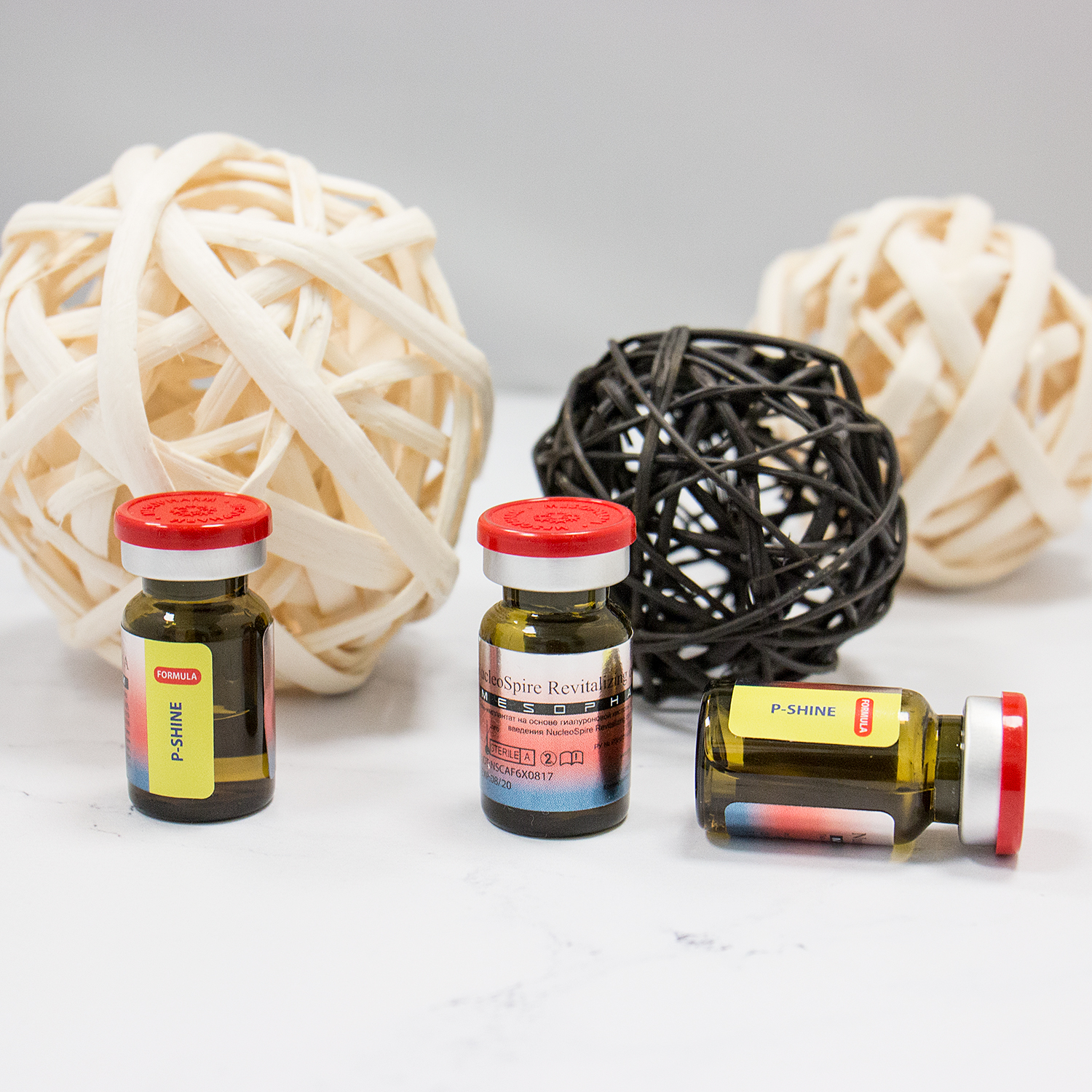
NucleoSpire complex A P-SHINE from Mesopharm designed to solve the problem of hyperpigmentation of various origins. Hyaluronic acid, vitamin C and glutathione in the composition, by binding free radicals, block the cascade of restorative reactions of melanogenesis, preventing pigment synthesis. Allantoin ascorbate and vitamin C block the work of tyrosinase, reducing the brightness of pigmentation. The whitening peptide inhibits the processes of melanogenesis, destroys already synthesized excess melanin, effectively lightening age spots. A decrease in pigment intensity is observed after 1-2 procedures.
Therapy
We always start the treatment process from simpler to more complex.
1. Systematic daily use of bleaching products in home care. It is preferable that the depigmenting products include active ingredients such as arbutin, white mulberry, kojic acid, ascorbic acid, retinyl palmitate. To achieve a therapeutic effect, it is recommended to use depigmenting cream for at least 6 months. It is advisable to apply the cream 2 times a day: in the morning - completely over the entire face, in the evening - locally on age spots. As a rule, this course of treatment takes the entire autumn-winter period.
2. Constant use of sunscreens. Preparations must have filters for both physical and chemical protection (titanium dioxide, zinc oxide, avobenzone, benzophneone). Sunscreen is always applied in the morning, regardless of the time of year.
3. Numerous professional cosmetic procedures aimed at enhancing desquamation and exfoliation of the epidermis or partial photodestruction of melanin-containing cells, depending on the cause of hyperpigmentation. Exfoliating procedures include scrubbing, microdermabrasion, and hydropeeling.
Scrubbing is a procedure aimed at cleansing and renewing skin cells. As a result of the procedure, the skin acquires a more even and healthy color.
Microdermabrasion of the face uses light abrasive removal of the upper stratum corneum of the skin, consisting of dead cells, which normalizes blood circulation, restores complexion, and reduces pigmentation.
Hydropilin g is an absolutely painless procedure, for which special vacuum attachments are used that gently and delicately remove dead skin cells from areas of the skin. As a result of the procedure, pores open, blackheads are removed, and metabolic processes in the skin are stimulated.
Chemical peeling . It is held mainly in autumn and winter. During this period, both superficial and medium chemical peels are actively used. Among the acids, glycolic, azelaic, trichloroacetic acids, and retinol are actively prescribed.
Glycolic acid , due to its low molecular weight, is extremely mobile. The mechanism of action is to reduce the cohesion of corneocytes, which promotes exfoliation and mechanical removal of pigment. The concentration of glycolic acid in chemical peels varies from 35 to 70%.
Azelaic acid blocks the synthesis of DNA and RNA in melanocytes and inhibits the activity of tyrosinase. The concentration of drugs can range from 5 to 20%. Azelaic acid is used to block melanogenesis before mid-peel peels.
Superficial peelings are always carried out in a course, on average, once a week from 4 to 6 procedures. The result of superficial peeling lasts, on average, from 4 months to six months.
Trichloroacetic acid (TCA) is rightfully considered a winter favorite. TCA is a very active acid; the whitening effect is achieved by exfoliating dead cells, which evens out the skin color. The TCA concentration can vary from 12 to 20%. Before TCA peeling, it is preferable to use cosmetics containing tyrosinase blockers for a month. The exception is peelings, which already contain saponins, due to which TCA penetrates more evenly into the skin. The procedure is carried out, on average, once every two to three weeks, no more than 3 times a year.
Retinol and its derivatives are often used to treat pigmentation, since retinol does not damage the skin and does not coagulate proteins. By interacting with its own nuclear receptors of basal cells, retinol increases the level of mitotic activity of keratinocytes, normalizes the processes of differentiation and keratinization in the epidermis, reduces the production of melanin, and reduces the number of atypical cells. Retinol peeling is done less frequently than other chemical peels - once every 1.5-2 months. Patients tolerate ON much more easily, since the period of recovery and rehabilitation is milder compared to TSA.
Mesotherapy is a method of administering active drugs through intradermal microinjections in order to obtain a therapeutic result. Drugs aimed at combating pigmentation can suppress melanin production and have a whitening effect. As a rule, whitening mesopreparations contain a huge number of components (about 30-45) tyrosinase inhibitors, antioxidants, and amino acids. Preference in the cocktail is given to such drugs as ascorbic, phytic, kojic acids, white mulberry, etc.
Ascorbic acid restores colorless melanin precursors (DOPA-chromium to DOPA-quinone) and inhibits tyrosinase activity at various stages of melanogenesis. The concentration of ascorbic acid in mesopreparations can vary from 15 to 25 mg.
Phytic acid is a tyrosinase inhibitor with strong antioxidant and anti-inflammatory effects.
Kojic acid is a safe and whitening ingredient that inhibits tyrosinase activity.
White mulberry is a plant whose extract contains the most aggressive tyrosinase inhibitor, hydroxyquinone. Its effectiveness as a bleaching agent has been proven in vitro.
Mesotherapy is carried out once every 7-10 days, on average, from 8-10 procedures per course, but the number can be more, up to 15. This depends on the severity and depth of age spots. Technique: deep attack and papules. Sometimes a course of mesotherapy can last almost the entire winter period. Most often it is combined with peelings. We get brighter and faster results from a combination of TCA peeling and mesotherapy.
Unfortunately, monotherapy does not provide complete whitening of age spots. Practice shows that it is possible to cope with pigmentation spots only with an integrated approach. Such a struggle is a long process that can last for several years, despite all the diversity of the cosmetology services market.
This article is part of the special project Injection anti-aging
You can read all the articles on this topic:
SPECIAL PROJECT. And injectable anti-aging
Literature:
Olga Antonyuk, dermatologist, cosmetologist, aesthetic medicine specialist
Cosmetologist No. 4, 2017
Read also
- Post-injection reactions: complications and side effects after mesotherapy
- From redness to anaphylaxis: diagnosis and emergency care for allergic reactions
- Results of "Christmas LION" 2025: when fairy tale meets science
- What does hyaluronic acid provide in skin care?
- In focus: a revolutionary solution for the treatment of all types of hyperpigmentation
- Hypoxia of aging: the role of microcirculation in the pathogenesis of age-related skin changes
- In focus: 4D strategy in skin care for hyperpigmentation
- Zero risk: general principles for preventing complications from chemical peels
- Glycation and skin aging
- 4rest (Forest), company
- Rosacea
- Couperosis
- Angioneurosis
- Peloid therapy
- Waxes for depilation
- Fordyce granules
- Bogomolets Olga
- Microneedle therapy