Face shapes and permanent makeup
You need to approach the permanent procedure consciously!
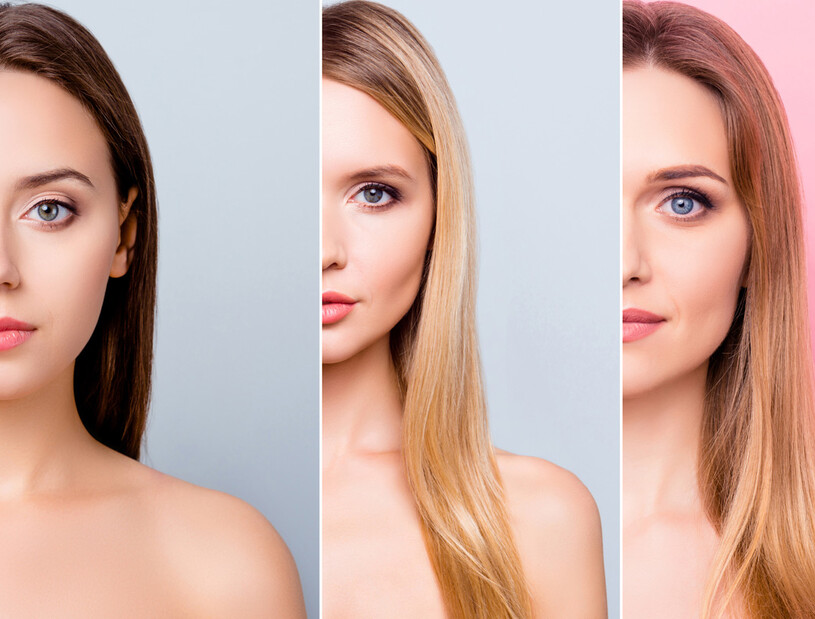
It is customary to reduce the whole variety of face shapes to basic geometric shapes. We will consider a classification option with the maximum number of typical forms so that everyone can find and determine their own type.
This time we will talk about the shape of the face and how to determine it.
It is customary to reduce the whole variety of face shapes to basic geometric shapes. In different typing systems, they are distinguished from five to eight. We will consider a classification option with the maximum number of typical forms, so that everyone can find and determine their own type.
Basic face shapes
So, the following main forms of the face are distinguished:
- oval,
- an elongated oval (or an elongated rectangle),
- circle,
- square,
- rectangle,
- triangle,
- trapezoid,
- heart,
- rhombus,
- polygon (diamond)
To determine the shape of the face, it is necessary to gather the hair tightly to open the forehead, ears and remove volume at the crown. What are the ways to determine the shape of the face? This can be done like this:
1. Camera. Take a full-face photo and take all measurements from the photo using a ruler or in a graphic editor. In this case, the most important thing is the correct shooting angle. The camera should be at eye level. Straighten your back, straighten your shoulders and try to keep your head straight without tilting back. Try to look straight ahead.
2. Mirror and something to draw on. Cosmetic pencil, lipstick or children's pencils for drawing on glass will do. Make sure the mirror is level, perpendicular to the floor, not tilted. Stand up or sit straight, circle your face in the mirror along the contour and mark the main points. All further actions can be carried out with the image on the glass.
3. Ruler, sheet of paper, pencil or pen. Apply a sheet of paper to your face along the main lines, make marks on it, and then draw segments along the ruler and measure the distance.
Read also
Forms in permanent makeup: we take into account image features
Determine the shape of the face
To begin with, we measure the length of the face from the hairline on the forehead to the line of the chin, and the width of the face along the bottom line of the eyes. If the length and width of the face are approximately equal, then the most likely options are circle or square .
Compare the width of the face along the line of the upper edge of the lips and the already measured width along the lower line of the eyes. If they are equal - most likely, your face shape is a square. If the width along the lip line is less - a circle.
Additionally, this can be checked as follows.
Take a piece of paper or a ruler and hold it to the side of your face. Look at the side line of the face: the less it deviates from a straight line, the closer the shape of the face to a square. The greater the deviation and the rounder the line, the closer to the circle.
If the lateral line of the face is close to a straight line, but the length of the face is greater than the width (the ratio is approximately 1.6) - probably the type of face is a rectangle . You can additionally check this by comparing the width of the line in the middle of the forehead and the width of the face along the line of the upper edge of the lips: in the case of a rectangle, these lines will be approximately the same. If the ratio of the length of the face to the width is more than 1.8 - the type of face is an elongated oval or an elongated rectangle. The subtype depends again on the degree of roundness of the chin. We consider it inappropriate to separate these subtypes, since the main characteristic of this type of face is elongation, the shape of the lower part of the face is secondary and does not draw attention to itself. If the chin is rather narrow, and the width of the line of the middle of the forehead is greater than the width of the face along the line of the eyes - most likely, the shape is close to triangular or heart-shaped.
The difference between these types of faces is in the shape of the hairline. Also, a heart-shaped face differs from a triangular one in softer, rounded lines and more pronounced cheeks.
If the line of the upper edge of the lips is greater than the line of the lower edge of the eyes and the line of the middle of the forehead, then the shape of the face is a trapezoid . If the lines are soft, rounded, there are no pronounced corners, the chin is round - this subtype of the trapezoid is called pear-shaped. If the lines are clear, the angles are pronounced, the jaw and chin are rather square - then this is a trapezoid in its purest form. If the widest part of your face is your cheekbones, then your face type is a rhombus or polygon. The diamond-shaped face is distinguished by a sharp chin, the widest line is the line of the cheekbones. The width of the line of the middle of the forehead and the line of the lips is much less than this line, the face as a whole is rather angular, sharp, the cheeks are not very pronounced.
Polygon face type (also called "diamond") - the widest part of the face - cheekbones, just like a rhombus. However, the angles of the jaw are more pronounced, a square chin is possible. In general, there can be from 6 to 8 protruding angles, sometimes more - hence the name "diamond".
And finally, the last type is oval . The ratio of length to width is approximately 1.6, no corners, smooth, rounded lines. The widest part is the lower line of the eyes, the line of the middle of the forehead is wider than the upper line of the lips. It is this form that is considered ideal, and the correction of other types of faces is aimed at bringing the shape closer to the oval.
So let's sum it up. To make it easier for you to navigate, we offer here such an algorithm with which you can determine your type of face by answering questions and moving along the arrows to the desired block.