Features of anti-cellulite taping in pregnant women and women taking COCs
Let's talk about the features of the tape application procedure during the period of taking COCs and pregnancy
The female body is unique. Many processes depend on the concentration of biologically active substances, primarily sex hormones. They also affect fat metabolism, so the effectiveness of anti-cellulite treatments may vary.
Tkachenko Svetlana Gennadievna , candidate of medical sciences, dermatovenerologist, associate professor of the department of dermatology, venereology and medical cosmetology of KhNMU, doctor of the medical center " European Dermatology ", Kharkov

In the previous article, we talked about how kinesio taping effectively helps in the fight against cellulite by improving lymphatic drainage and the overall elastic characteristics of tissues. Considering that “orange peel” is a feature of fat deposition, which, due to hormonal characteristics, in most cases occurs in women, it is worth understanding how to properly work with patients with hormonal characteristics - pregnant women and those taking combined oral contraceptives.
Kinesio taping in the correction of cellulite in women taking COCs
A randomized, controlled, blinded study by Brazilian specialists was published, in which 24 women with cellulite of the gluteal region I-III degrees took part [1]. The study included non-pregnant women leading a sedentary lifestyle and taking oral contraceptives. 12 women (20-30 years old, 50-70 kg) received kinesio tape applications on the gluteal area with a tension of 0-15% once a week, 4 times. The control group (without the use of kinesio taping) also included 12 women of similar age and weight. We used symmetrical horizontal applications of fan tapes in the buttock area with anchors directed into the intergluteal fold. The branches of the tape ended on the anterior surface of the thigh in the projection of the greater trochanter. A significant reduction (p<0.01) in the severity of cellulite by photogrammetry was documented in the group of women who used kinesio tape. For other indicators (changes in weight, body volume), no significant difference was detected.
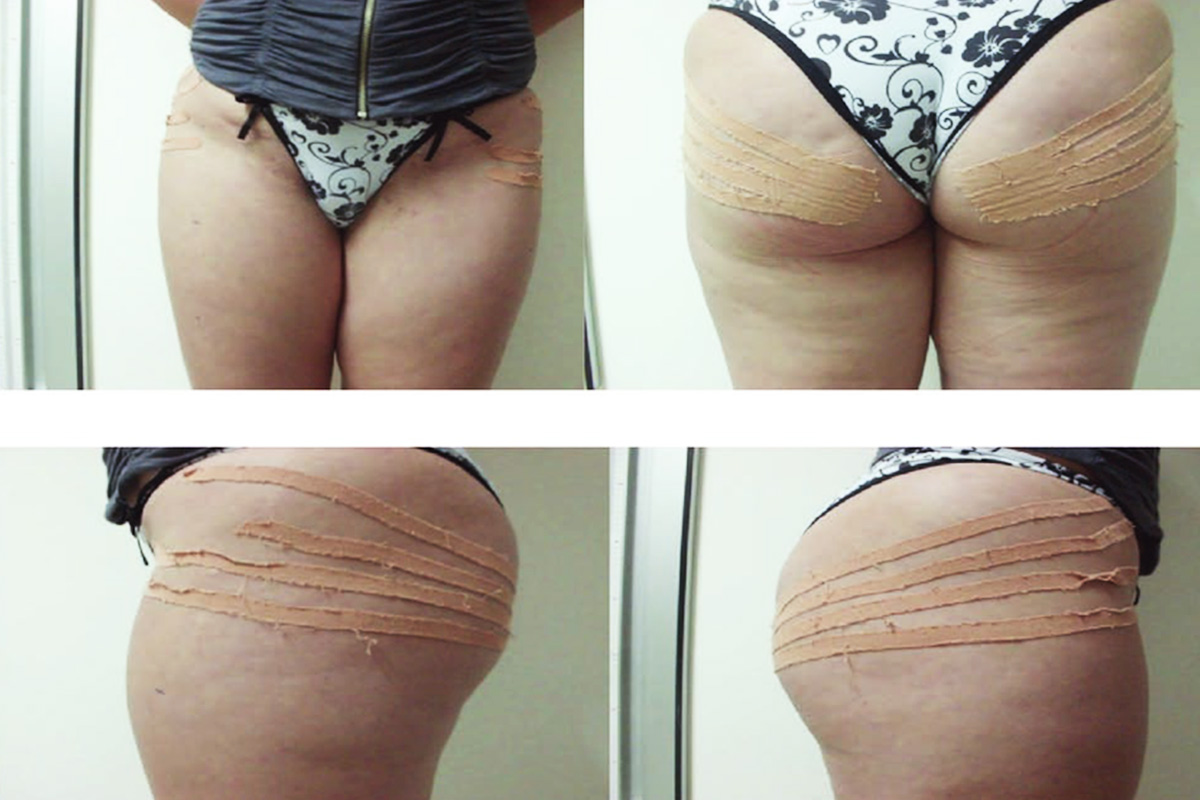
Source [1]
According to my observations, for the correction of cellulite in the gluteal region, vertical application with anchor placement in the projection area of the lumbar lymph nodes is more effective.
However, it is the horizontal gluteal application that is found in publications when working with pregnant women and using COCs. Such an application is absolutely justified when working with pregnant women (with vertical application, the anchor will be located directly in the projection of the Michaelis rhombus) and may be associated with relative contraindications, which were the reason for prescribing hormonal therapy in this study.
As for volumes, in my practice, anti-cellulite taping in the hips and buttocks area really has little effect on volumes. Therefore, patients should not be oriented toward reducing the volume of their hips and buttocks after a course of anti-cellulite taping.
The picture is completely different with lymphatic drainage kinesiotaping of the abdomen. And this applies not only to the problem of cellulite. An increase in waist circumference may be associated with the accumulation of visceral rather than subcutaneous fat and with the accumulation of fluid in the abdominal cavity. The most illustrative example from my practice is a consistent reduction in abdominal volume by 3 cm after each of three (9 cm in total) lymphatic drainage applications of tape in the abdominal area (with anchors to the inguinal lymph nodes and to the thoracic lymphatic duct) and the lateral surfaces of the torso (with anchors to lumbar lymph nodes).
Anti-cellulite taping and pregnancy
Hormonal and biomechanical changes during pregnancy contribute to the formation of gynoid lipodystrophy. Traditionally, such patients are recommended manual lymphatic drainage, which creates a pressure difference, facilitating the passage of intercellular fluid and lymph and the evacuation of waste from cellular metabolism. This procedure helps improve blood circulation, remove toxins and reduce fluid retention, activate cellular oxygenation, stimulate lactation and desensitize the breast, preparing the patient for breastfeeding. Kinesio taping has similar effects and a similar range of contraindications.
The essence of the study
This is one of the first studies to study not only anti-cellulite kinesiotaping, but also manual lymphatic drainage during the gestational period, which was small, but still randomized and controlled.
Specialists from Brazilian universities (Centro Universitário Escritor Osman da Costa Lins - UNIFACOL. Vitória de Santo Antão, Universidade Federal de Pernambuco (UFPE), Recife) conducted a randomized controlled study comparing the effectiveness of manual lymphatic drainage and a combination of manual lymphatic drainage with kinesio taping in the correction of cellulite in pregnant women . The study included pregnant women from the 14th week of pregnancy aged 18 to 45 years with a single fetus. Pregnant women with some clinical instability, diagnosed with uncontrolled gestational hypertension, renal failure and deep vein thrombosis were excluded due to contraindications to the procedure.
results
The results of the study showed a significant decrease in the manifestations of gynoid lipodystrophy in pregnant women in groups receiving manual lymphatic drainage (10 women) and a complex of manual lymphatic drainage with kinesio taping (10 women) compared to the control group (10 women). There was no significant difference in clinical effectiveness between the groups receiving manual lymphatic drainage and manual lymphatic drainage with kinesiotherapy. For pregnant women, symmetrical horizontal applications of fan-shaped tapes were used in the buttock area with anchors directed into the intergluteal fold (as in the study with COCs. - Author's note). The branches of the tape ended on the anterior surface of the thigh in the projection of the greater trochanter [2].
The study design was approved by the ethics committee in accordance with the national MoH regulation (CAAE no. 86064118.2.0000.5195 and opinion number: 2.650.349). Such works are very valuable for both kinesiotherapists and gynecologists, since they regulate the use of adjuvant methods so popular among the population in clinical practice. The prejudice of specialists and patients is associated with a lack of respectable information and experience. It is imperative that professionals dealing with such problems document and publish treatment results using clearly established procedures and methods.
Bibliography:
[1] da Silva, R. M. V., Cavalcanti, R. L., Rêgo, L. M. D. F., Nunes, P. F. L., & Meyer, P. F. (2014). Effects of Kinesio Taping® in treatment of Cellulite: Randomized controlled blind trial. Manual Therapy, Posturology & Rehabilitation Journal, 12, 175. https://doi.org/10.17784/mtprehabjournal.2014.12.175
[2] Delgado, A., de Queiroz Araújo, D. L., Lourenço Da Mata, M. J., Batista Da Costa, H. M., da Cruz Silva, G., Rattes, C., & Guerino, M. R. (2021). Effectiveness of manual lymphatic drainage associated with functional banding in the clinical improvement of gynoid lipodystrophy in pregnant women: a clinical, controlled and randomized trial. O Mundo Da Saúde, 45, 010–023. https://doi.org/10.15343/0104-7809.202145010023