Tattoo removal with a remover: how to avoid mistakes
How to remove low-quality permanent makeup without leaving marks
Permanent makeup is a fairly popular procedure for modern girls. But with the increasing popularity of the procedure, the problem of old low-quality tattooing and, accordingly, its removal arose.
The devil is not so terrible as a poor-quality eyebrow permanent (folk wisdom)
Removing an old tattoo is not an easy task, therefore it requires a special approach and high qualification of the master. As a rule, these procedures are performed using laser technology or a special remover. In rare cases, specialists may resort to surgical intervention.
Today we’ll talk about removal with a remover so that you are fully equipped and don’t make mistakes that can lead to an even greater exacerbation of an already existing problem.
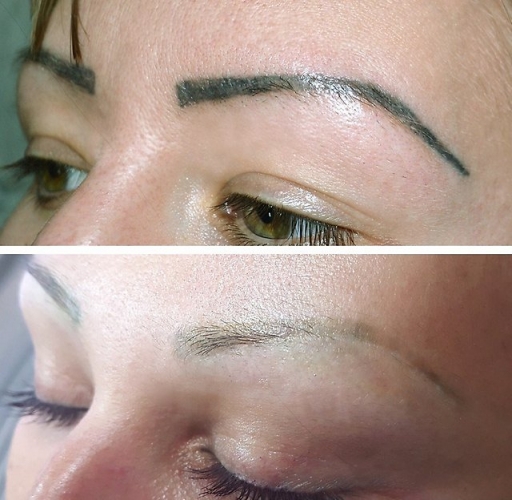


The essence of the method
At their core, removers are suspensions that can bind to pigment molecules stabilized in the skin and remove them from the tissues of the skin. Depending on the active component , acid, hydrochloric and alkaline removers are distinguished. Acid is divided into three main groups: single-acid, two-acid, multi-acid. Another classification of acid removers: single-phase, two-phase, three-phase.
In other words, a remover is a certain chemical composition that is introduced into the skin using a permanent makeup machine (just like a pigment), inside it breaks down the paint and brings it out.
.png)
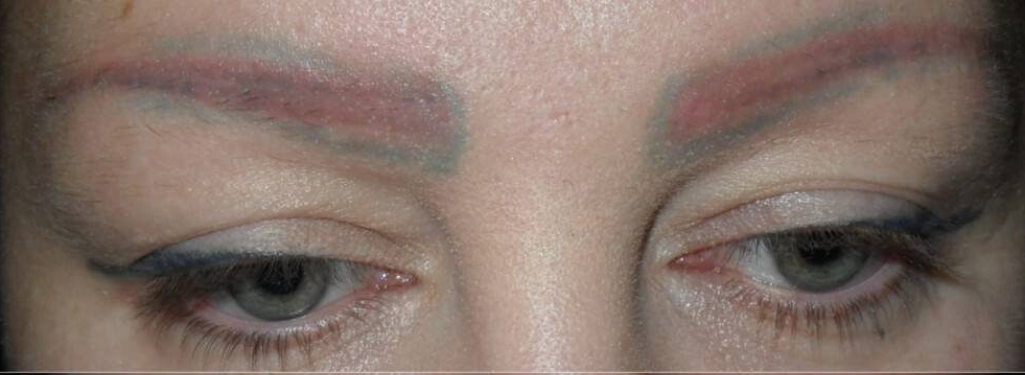
When do you need help from a remover? Experts advise to combine these two types of removal of pigments from the skin. The combination of laser and remover allows you to remove any tattoo. As long as the color is bright, you need to use a laser. A remover is a method of removal when the laser no longer “sees” the pigment, and it should only be used in cases where the color is “stuck”, or it is blue, light green, white, beige colors - the most complex tones that are very difficult to leave the skin.
.png)
.png)
But do not forget that between the procedures you need to do large cycles of tissue repair (6-8 weeks).
Low-quality permanent makeup: features of laser and remover removal
Very often, clients require the removal of permanent make-up of eyebrows due to their irregular shape, bad color, or poor work of an unskilled cosmetologist. In second place in demand for the procedure is the removal of tattoo from the lips: it is required if you need to change the color or eliminate configuration defects. It is worth noting that it is not recommended to remove tattoo on the eyelids (removal of inter-ciliary tattoo) using removers, since accidental contact with the substance in the eye can cause burns and damage to the visual organ.
Procedure technology
When using a remover, the upper layer of the skin is damaged, as in the usual tattoo procedure. The drug is applied to the depth at which the pigment lies. The task of the drug is to bring the pigment to the surface. Duration of the procedure: an average of 30 minutes per procedure.
Stage 1. Antiseptic treatment
We clean the skin of the face and treat it with an antiseptic. We apply primary anesthesia with a thin layer under the film on the treated area for 20-25 minutes. By the way, according to the sensations, the removal procedure with a remover is less painful than a laser. Like tattooing, it can be done with or without anesthesia.
Stage 2. Removal of pigment from the skin
We remove the remnants of anesthesia with a dry cotton pad. If you work with a two-phase remover, then apply the first composition of the remover for 3 minutes on those places from which you need to remove the pigment. We work on the necessary areas of the skin. There is a slight peeling, the skin "opens". Then, with a dry cloth, remove the first composition of the remover.
We prepare the device, we collect the remover, as well as the pigment for the PM, we carry out the procedure. In this case, we work not with strokes, as, for example, with powder technique, but pointwise. The remover then penetrates deep enough and takes out the pigment. We hold the apparatus strictly vertically, the penetration of the needle is 90 °. After the first pass, we blot the pigment that came out with a cotton swab, do not cover the treated area with anything.
First, those pigments that are more superficial begin to come out. To remove an old tattoo, it will take from 2 to 6 procedures. Recall that the interval between procedures should be at least 4 weeks. Sometimes more procedures are required. It also happens that not all the pigment is removed. It is important to understand that everyone is individual. At a personal consultation, the master can give an approximate forecast of the number of procedures and the expected effect. More precisely, how the skin and pigment will behave when removed, you need to look in the process.
The healing period and care of the treated area is the same as after the permanent makeup procedure. Complete (internal) healing occurs after 28 days. Only after a complete skin regeneration process is the end result visible.
Just like lasers, removers are safe only in the hands of professionals! It is easy to get scars from an acid remover, if it is not in experienced hands. Only an experienced master will be able to do the procedure with high quality.