Permanent makeup needles: classification from a to z
What to look for in the process of choosing needles for permanent makeup
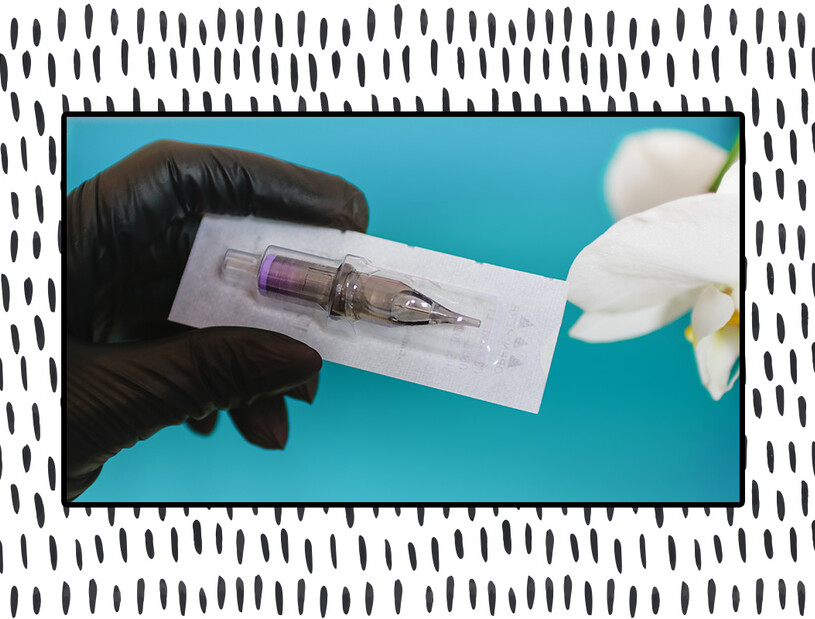
The qualitative result of tattooing or permanent makeup procedures largely depends on the qualifications and experience of the master. But what materials are used is also important: apparatus, pigments and needles.
With the help of a needle, a small puncture is created in the upper skin, through which the coloring pigment is injected. Therefore, it is very important to pay special attention to the choice of these elements. In our article, we will dwell on the questions of what kind of needles for tattoos and permanent makeup are, what to look for in the selection process.
In the process of performing any kind of procedures (drawing a contour, drawing a shadow, filling in the general background), to ensure the required quality, it is necessary to carefully select all the details. When using a specific technique, you need to use a specific set of needles. So, when painting over tattoos, experienced craftsmen use textured elements. This makes it possible to introduce the maximum amount of pigment under the skin, although this technique involves a greater amount of damage. In the process of permanent makeup, finer contour lines and fine details are applied. With this procedure, thin needles are used, which provide the opportunity to minimally damage the skin.
foundation of the foundations
According to the needle sharpening technology, there are:
- sharp (long sharpening);
- average;
- blunt (bullet-shaped).
The latter are used to achieve a higher filling density by supplying the maximum amount of pigment or shading. Such products outwardly stand out with a slightly rounded tip and are best suited for painting over tattoos. Needles of medium sharpening are universal, which makes it possible to use them for most types of devices and in various areas of the body. Sharp sharpening is used when carrying out small procedures or for drawing especially thin lines, a contour.
Beam types of needles
With the development of technology, needles for tattoos and micropigmentation began to solder into special bundles. This made it possible to significantly speed up the work of the master, especially in large areas. Such products differ from each other in the form and number of elements in the composition, purpose.
Magnum - are painting needles. They are divided into separate subtypes: M1 (made in the form of a single row, but the elements at the ends diverge in a checkerboard pattern, intended for use when applying light shading, from light transparent to dense shading); M2 (tightly soldered into a single space in two rows, can be used to perform deep painting);
Round Magnum is one of the safest types of needles. Cause minimal damage to the outer integument of the skin of the body. Soldered into the shape of a crescent. Used for light staining.
Round Liner (RL) - needles connected (also known as "reduced") into a single oval spike. It is used to draw the contours of the image. The thickness of the products directly depends on the number of interconnected needles. Used in the micropigmentation procedure for detailed drawing of lines and elements;
Round Shader (RS) - these types of products are used when painting over a tattoo or shading. They differ from RL by the parallel arrangement of needles in the spike (“divorced”). Suitable for shadow types of work;
Flat - flat (or “flats”), the needles are soldered in one row, the solder itself stands out with a high degree of density. Allow to provide alternation of colors and halftones when drawing the image. Used for heavy coverage. They can be used when drawing elongated lines, however, this technique requires a high level of skill from the master;
RM, RF - flat types of rounded soldering, consisting of needles of various lengths. They allow to provide a higher level of work safety, uniform painting of the contour, softness of shading.
In spikes, the number of needles used may vary, depending on the intended purpose. As for the micropigmentation procedure, bundles containing from 2 to 7 soldered needles are usually used here.
Needle configuration
Needle configuration is the number and shape of needles (tips) soldered to the main needle. Permanent makeup needles can have a wide variety of configurations. Each manufacturer produces its own set of possible configurations. And the wider this set, the more technical capabilities the master has. For some manufacturers, this set consists of 3-4 configurations, for others - from 10-14 configurations.
Possible needle configurations (Fig. 1)
Various configurations of needles allow you to perform various necessary permanent makeup techniques to achieve the highest quality of the procedure. The use of different needle configurations allows the master to reduce trauma and reduce the time of the procedure.
Choosing a needle
The principles for choosing a specific needle configuration are that:
- a larger number of needles soldered to the rod provide greater coverage;
- the larger the area of \u200b\u200bthe “imprint” of the needle, the greater the resistance to the needle is provided by the skin.
The single-channel needle has the smallest covering power and the deepest penetration into the skin. The multi-channel magnum has the highest hiding power and the least deep penetration into the skin. Thus, the needles with the smallest "footprint" (single-channel, three-channel liner, three-channel round, five-channel liner) are intended for drawing contour lines. Such as lip contour, arrow contour, hairs. All other configurations of needles are used for painting the working area (dense painting, shading, watercolor technique).
Different manufacturers of needles of the same configuration may differ in the size of the “imprint”.
Each device has its own needle
The permanent makeup industry has been developing for several decades. Over the past time, not only the method of applying pigment to the skin has changed, but also the tools themselves. In the world there are a large number of the most diverse devices and, of course, many different types of needles for them, each master approaches the choice of which with special attention. Needles for different designs of devices are also very different. These can be long tattoo needles with holders and attachments used for tattoo equipment; short needles with nozzles (caps); needles pressed onto a plastic base for easier replacement; non-separable modules, consisting of a capsule in which a needle and a nozzle are placed.
The needles may have protective membranes that prevent the ingress of liquids and contaminated air into parts of the apparatus that are not subject to sterilization.
Safety is paramount!
The only thing that unites all types of needles, nozzles, caps, modules is that they are all disposable.
All manufactured needle kits must be sterile. Before carrying out the procedure in the direct presence of the client, the master must open the package using a special indicator. But, unfortunately, sometimes you come across information that allows you to understand that some masters use consumables repeatedly (for example, used needles are not disposed of, and after the initial procedure they are put away in an envelope (with the client’s name signed on it), and then they are used a second time for correction). And such “professionals” are not embarrassed that the needle simply becomes dull after the procedure, not to mention the fact that particles of tissues and liquids remain on it for a long time, and it cannot be cleaned and sterilized.
The trust of the client to the master is one of the components of the success of the procedure, and in no case should it be abused. Of course, modern equipment with the use of consumables is expensive, but the master is responsible for the health of the client, and the savings here are simply criminal.