For every taste: methods of applying foundation
Perfect skin
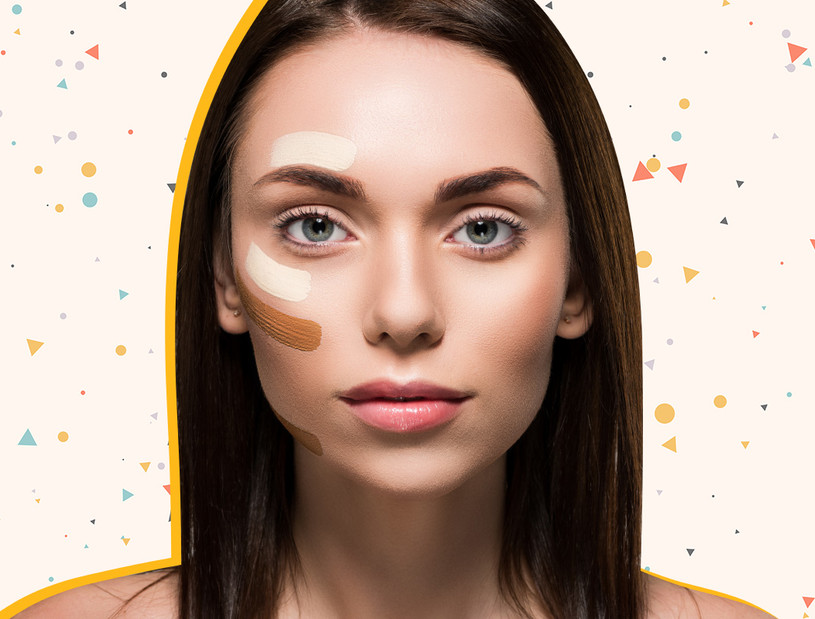
We talk about a variety of methods for applying foundation using your fingers, brush and sponge.
Lighting plays a key role when applying tone. If you apply makeup under artificial lighting, keep in mind that an overhead light source will cast harsh shadows and the color of the walls may change the shades of your makeup. The best option is evenly lit white walls and lamps (preferably daylight) on both sides of the mirror. When applying makeup, take into account the nature of the lighting and the place where you are gathering the client.
You need to apply foundation from the center to the periphery, along massage lines. The neck and décolleté area should be tinted only if the tone applied to the face is darker than the natural skin tone. If you are doing daytime makeup, you need to walk along the edge of your face, bringing the foundation slightly down onto your neck. Also carefully blend the transitions to the base of the hair.
Each makeup artist has his own answer to the question of how to apply foundation correctly: with your fingers, a brush or a sponge. By the way, none of the options is the only correct one, and each has its own pros and cons, its own advantages and disadvantages. Let's take a closer look at each method.
Applying tone with your fingers
This method is favored by many professional makeup artists in the US because the fingertips have the best feel for the skin. I would like to note that applying the tone with your fingers is very convenient. Firstly, you can save up to 30% of the cosmetic product, and secondly, it is much easier to feel the texture of the skin with your fingers. Their warmth allows the product to lay down in a more even layer on the surface of the face and penetrate into places where it is quite difficult to reach with a sponge.
In addition, it is easy enough to wash your hands before and after applying makeup, while sponges and brushes require more painstaking care. But this application method does not always allow you to achieve a perfectly even coating; in addition, it requires some experience.
How to apply foundation with a brush
A foundation brush must be artificial (synthetic fiber), since natural bristles absorb up to 80% of the product. It is this tool that allows you to create the densest coating. There are several types of brushes for applying tone.
Duofiber brush (mixed bristles: synthetic + goat). The peculiarity of brushes of this kind is that they provide a veil coverage, and you can create a very natural beauty look. This brush is similar to an airbrush in applying tone. If the client or model does not have significant problems on her face and dense masking of imperfections is not required, this brush will be ideal. With its help, the tone is distributed evenly, without a mask effect, with a light veil. This is a great option for natural daytime makeup. This brush is also perfect for aging skin, as it allows you to apply the foundation in a thin layer without sinking it into wrinkles. The foundation is applied in a circular motion and the brush is held perpendicular to the face.
Flat synthetic brush. This is a classic. This brush applies the tone most densely and smoothly. A regular flat brush has hairs matched to one another so that it becomes thinner towards the tip. It should also be semicircular in shape to make it more convenient to work on the nasolabial folds and the area under the eyes. All flat brushes, like all brushes for cream textures in general, are made of artificial fibers, as they do not absorb cosmetics. In addition, foundation brushes need to be washed after each use, and artificial fibers withstand washing better. Using a flat brush, foundation is applied along massage lines.
Kabuki brushes (synthetic fiber) . They come in different shapes - straight and beveled, even, straight and beveled semicircular. Depending on the shape, the brush can be used both as a round mixed brush, that is, applying tone in a circular motion, and as a kind of sponge, i.e. Apply tone using patting movements. All kabuki brushes are very dense, so they are convenient for blending the foundation, thereby controlling the density of application. With careful shading, the tone will be almost invisible.
How to apply foundation with a sponge
Dry and wet sponge. Thick foundations are suitable for application with a dry sponge ; liquid foundations are simply absorbed into it, leaving nothing behind for makeup. Using a dry sponge you get a fairly dense coating. However, the disadvantages of this method include a fairly large consumption of the product, as well as a more noticeable coating on the skin than when using a damp sponge.
Beauty Blender. Its elliptical shape with one pointed end and the other rounded end provides access to all areas of the face, including the inner corners of the eyes, the wings of the nose, etc. At the same time, the Beauty Blender perfectly absorbs water (namely water, not cream), increasing at the same time in size and becoming even softer and more pliable. It is very easy to use. Leaves no marks or boundaries.
To achieve the best effect, many makeup artists use two (or even three!) methods of application at once: they paint over complex areas with a brush, apply the cream with their fingertips and/or a sponge. Which method to choose is up to you.