Laser carbon peeling: a must-have procedure in summer
A variety of peelings in aesthetic cosmetology opens up the possibility of targeted solutions to various aesthetic and physiological problems of the client’s skin. Let's figure out what the advantage of laser carbon peeling is.
Elena Krasnoshchek , cosmetologist at Medikalaser company
Denis Tikhoruk , owner of the Medikalaser trademark
One of the main advantages of using peelings is ease of use and quick results. But there is still one “but”! Most of the actual peelings are not recommended to be used in the summer in order to avoid complications. Why is that?
The principle of chemical peeling is based on the breaking of protein bonds between cells due to various types of acids included in its composition. A few days after the session, the client’s skin begins to actively peel off. As a result, we get smoother, more beautiful skin, pigmentation lightens and wrinkles decrease. But at the same time, after active peeling, the skin becomes vulnerable to exposure to solar radiation, and there are risks of undesirable consequences in the form of pigmentation.
What to do if you really don’t want to give up peelings and have beautiful skin even in the summer? Hardware types of peelings come to the rescue, namely LCP (lasercarbon peeling ). Its principle of influence is based on the combined use of a special gel for the procedure, and a specific laser, namely a short-pulse or ultra-short-pulse neodymium laser from TM Medikalaser , and a special attachment.
The gel for laser carbon peeling contains carbon nanoparticles, moisturizing components (hyaluronic acid, water) and nourishing ingredients (oils, vitamin E). The composition of the gel ensures its high adhesiveness (gluing) when applied to the skin, which in turn leads to the absorption of sebum, dead epithelial cells, dirt, pathogenic flora, etc. by the gel particles. The gel itself in no way disturbs the cells and their protein connections, so carbon peeling does not cause peeling after sessions and it can, and even should, be carried out in the summer.
What effects does peeling give? Considering that the carbon gel actively “glues” everything unnecessary and gets deep into the pores, after the session we can immediately observe the following results:
- Cleansing pores, eliminating comedones, drying inflammatory skin elements.
- Leveling the surface, reducing porosity, improving skin color.
- Smoothes out wrinkles and leaves your skin incredibly smooth.
But laser carbon peeling has not only a cleansing effect. Due to the fact that at the time of the session there is an active effect of laser radiation, we receive a powerful warming and stimulating effect on the deeper layers of the skin. The effect will not be noticeable immediately, but after several sessions, and it is manifested by the following results:
- Lightening of surface pigmentation, reduction of skin dyschromia.
- Narrowing of skin pores.
- Visible reduction of wrinkles and skin creases.
- Lifting effect.
- Increasing skin density and elasticity.
- In complex work with acne: reduction or complete disappearance of inflammatory elements, normalization of seboregulation, absence of comedones. For post-acne scars: smoothing and lightening.
The average course of laser carbon peeling procedures consists of 6-8 sessions every 5-8 days. The course can be repeated at the client’s request after a couple of months or several maintenance procedures can be done 1-2 times a month.
Laser carbon peeling goes well with almost all hardware and care procedures in cosmetologists:
- Chemical peels, carboxytherapy.
- Facial cleansing: manual, hydropeeling, ultrasonic.
- Biorevitalization and mesotherapy.
- Hardware techniques: RF lifting, microcurrent therapy, phonophoresis, ELOS technology, etc.
Stages of laser carbon peeling
Stage I. Makeup removal and cleansing according to the client's skin type. It is possible to use delicate rollers, products with AHA acids, foams and washing gels. After which we wipe the client’s skin with chlorhexidine.
Stage II. Application of carbon gel. Apply a small amount of gel to the client's cleansed and dried skin using rubbing movements. The main factor is not the thickness of the layer of the gel itself and the intensity of its color, but that it is absorbed into the client’s pores as much as possible and repeats the skin pattern. Leave the gel for 20-25 minutes until it dries.
Stage III. After exposure to the gel, we put on glasses for the client and the technician. This stage is mandatory and necessary to protect the eyes during the session.
Stage IV. We blot the remaining gel using dry wipes. This is done to ensure equal absorption of laser radiation and uniform intensity of work throughout the entire procedure area.
V stage. We put a special attachment on the laser handpiece for carbon peeling or set the required wavelength and width of the outgoing pulse in lasers with built-in attachments (ultra-short lasers).
Stage VI. We set the parameters recommended for a specific model on the device screen and carefully knock out all the gel from the client’s skin.
Stage VI. We finally cleanse the client's skin. To do this, remove the remaining gel first with dry cotton sponges, and then soaked in chlorhexidine.
VII stage . Apply a skin care serum or mask to your skin according to your skin type. In the summer, it is recommended to apply cream with SPF protection.
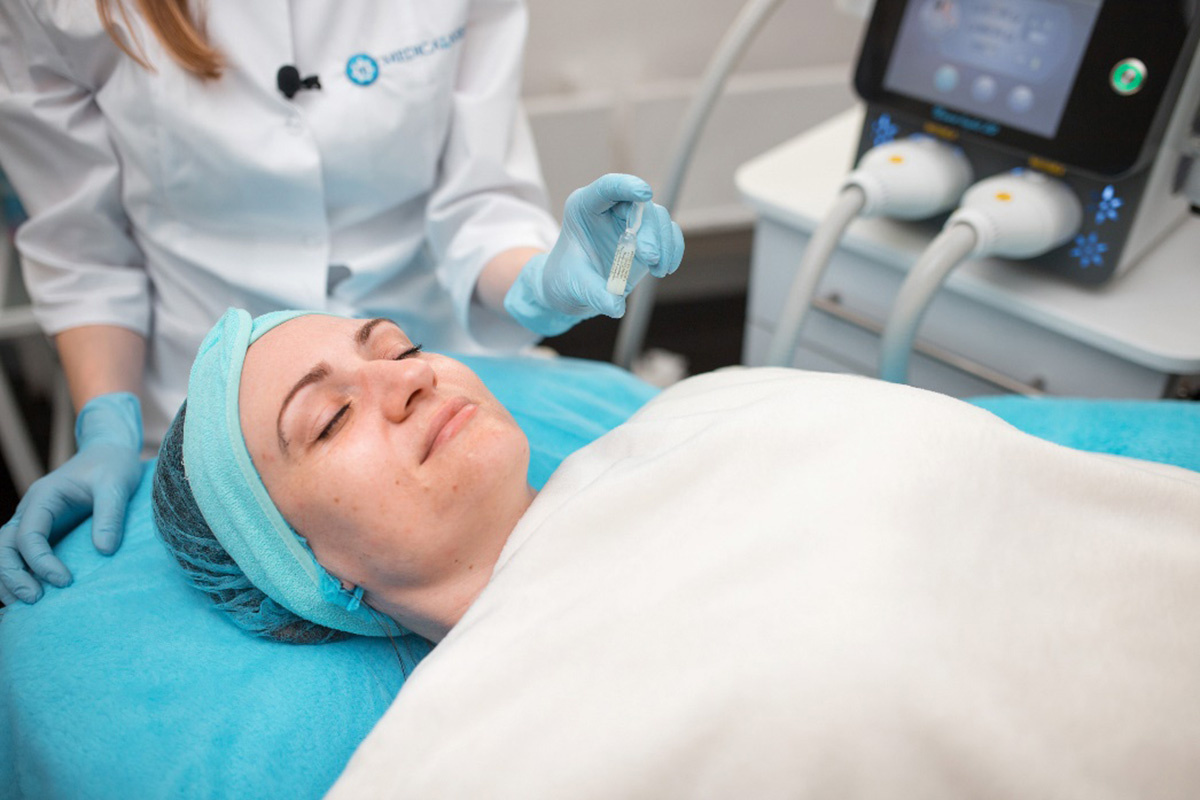
In conclusion, I would like to note that laser carbon peeling is an absolutely comfortable and even pleasant procedure for the client. During the session, moderate warmth and tingling sensations are felt here and there. After the procedure, slight redness is observed, which will subside within 20-40 minutes.
Also, do not forget that carbon peeling sessions can be carried out not only on the face: it has shown itself to be excellent in combating acne on the back and décolleté, and rejuvenating the hands and neck. Be sure to try this procedure for yourself and appreciate its wonderful effect on the skin.
Read also